
Intermittent Fasting and Macro Tracking

Kelli • September 9, 2020

Intermittent Fasting and Macro Tracking

Last week we discussed Paleo vs Whole30 diets.  And while we are not here to tell you what healthy diet is the best for you, we want to provide you the information on several common ones so you can choose what the best is for you and your lifestyle.  This week we are discussing 2 other lifestyle changes that are not necessarily diets, but still affect overall nutritional health.


Intermittent Fasting:

Intermittent Fasting, also known as intermittent energy restriction, is a meal timing schedule that cycles between voluntary fasting and non-fasting over a given period.  You can drink water, coffee and other zero-calorie beverages during the fast, which can help reduce feelings of hunger.  It is very important to primarily eat healthy foods during your eating window.  This method does not work if you eat excessive number or calories or “bad” food.

Johns Hopkins neuroscientist Mark Mattson, Ph.D., has studied intermittent fasting for 25 years. He says that our bodies have evolved to be able to go without food for many hours, or even several days or longer. In prehistoric times, before humans learned to farm, they were hunters and gatherers who evolved to survive — and thrive — for long periods without eating. They had to: It took a lot of time and energy to hunt game and gather nuts and berries.  Mattson’s research also shows it can take two to four weeks before the body becomes accustomed to intermittent fasting.  You might feel hungry or cranky while you are getting used to the new routine.  But, his research shows those who make it through the adjustment period tend to stick with the plan as the subjects noticed they feel better.  Another study he conducted showed results in a metabolic switch of burning more fat resulting in protecting organs against chronic diseases like type 2 diabetes, heart disease, age-related neurodegenerative disorders, even inflammatory bowel disease and many cancers.

Benefits:

  • Thinking and Memory Boost
  • Heart Health
  • Physical Performance: fat loss while maintaining muscle mass and endurance in running
  • Prevention of diabetes and obesity
  • Tissue Health: reduce tissue damage in surgery and improved results


16:8 Method: (Leangains Protocol by Martin Berkhan)

Fasting every day for 14-16 hours and restricting your daily eating window to 8-10 hours.  Can be as simple as not eating anything after dinner and skipping breakfast
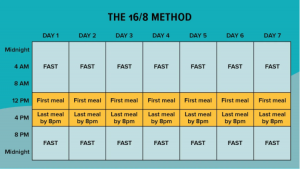
Diagram illustrating the 16/8 intermittent fasting method: daily 16-hour fasting with an 8-hour eating window.

5:2 Method: (Fast Diet by Michael Mosley)

Involves eating normally 5 days of the week while restricting your calorie intake to 500-600 for 2 days of the week.  (Note there is limited research on this method and it is generally used as a kick start method to begin true intermittent fasting)
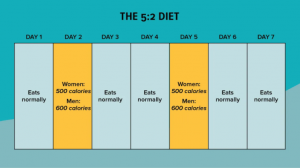
Diagram of the 5:2 diet, showing days of normal eating and days of restricted calories for women and men.

Eat Stop Eat Method: (By Brad Pilon)

Involves a 24 hour fast one or twice per week.  By fasting from dinner one day to dinner the next day, this amount to a full 24-hour fast.
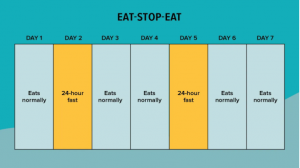
Eat-Stop-Eat diet plan: alternating days of normal eating and 24-hour fasts.

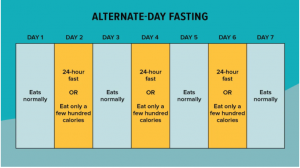
Alternate-day fasting Method:

Involves fasting every other day – allows for about 500 calories during the fasting days.  This is less extreme than the full fast every other day and is recommended for beginners.

Diagram illustrating alternate-day fasting. Shows eating normally on some days, fasting or low-calorie on others.

The Warrior Diet Method: (By Ori Hofmekler)

Involves eating small amounts of raw fruits and vegetables during the day and eating on huge meal at night.  Basically, fast all day and feast at night within a four-hour eating window
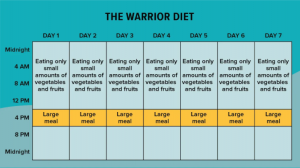
Diagram of the Warrior Diet plan: eating small amounts of vegetables and fruits then one large meal daily.

Spontaneous Meal Skipping Method:

It is a myth that people need to eat every few hours or they will hit starvation mode or lose muscle.  The body is able to handle long periods of famine and can miss one or two meals from time to time.  This is another option to simply skip meals from time to time if you are unable to follow a structured intermittent fasting plan.  However, the meals need to be healthy meals during this fasting.
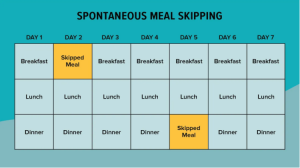
Meal skipping chart for a week, highlighting skipped meals on days 2 and 5.

Intermittent Fasting Resources:


Macro Tracking:

               Macro Tracking refers to logging your daily food intake to track the calories and types of foods you eat in order to achieve certain macronutrient and calorie goals.  Macronutrients include Carbohydrates, Fats and Proteins.  Simply speaking Carbohydrates include sugars, starches and fibers (such as grains, starchy vegetables, beans, dairy products and fruits).  Carbohydrates provide 4 calories per gram; depending on the type of diet you are following the average consumption per day 45-65% of your daily calorie goal.  Fats are found in foods such as oils, butter, avocado, nuts, meat and fatty fish.  Fats have the most calories of all macronutrients, providing 9 calories per gram.  Your body needs fat for energy and critical functions, such as hormone production, nutrient absorption and body temperature maintenance and average consumption per day is 20-35% of total calories.  Proteins provide 4 calories per gram and are vital for processes like cell signaling, immune function and the building of tissues, hormones and enzymes. Protein-rich foods include eggs, poultry, fish, tofu and lentils.  The average consumption of protein is 10-35% of daily total calorie intake.

Now that you understand what macronutrient is and the average ratios for each; how do you begin to count them daily? First you need to figure out how many calories you need for each day.  This number will vary daily depending on your Resting Energy Expenditure (REE) and Non-Resting Energy Expenditure (NREE).  REE are the number of calories you burn at rest and NREE are the number of calories you burn with activity. When we add REE and NREE this give you the total number of calories burned in a day – your Total Daily Energy Expenditure (TDEE).  Confused Yet?! Don’t be…. There is a simple calculation below you can use to calculate your overall calorie needs OR use this simple online calculator: Calorie Calculator

  • Men:  calories/day = 10 x weight (kg) + 6.25 x height (cm) – 5 x age (year) + 5
  • Women:  calories/day = 10 x weight (kg) + 6.25 x height (cm) – 5 x age (year) – 161

Then, multiply your result by an activity factor — a number that represents different levels of activity:

  • Sedentary:  x 1.2 (limited exercise)
  • Lightly active:  x 1.375 (light exercise less than three days per week)
  • Moderately active:  x 1.55 (moderate exercise most days of the week)
  • Very active:  x 1.725 (hard exercise every day)
  • Extra active:  x 1.9 (strenuous exercise two or more times per day)

Example: A 42 year old female that weighs 140 pounds and height of 5 feet 2 inches and a lightly active lifestyle: (Answer: 1,716.34)

  • Calories/day = 10 x 63.50kg + 6.25 x 157.48cm – 5 x 42 – 161
  • Calories/day = 1,248.25
    • Note 1 pound = 0.454 kg
    • Note 1 inch = 2.54 cm
  • Calories/day x lightly Active lifestyle: 1,248.25 x 1.375 = 1,716.34

This is now your TDEE and your daily calorie intake.  Calories can be either added or subtracted to reach different goals – e.g. muscle mass (increase calories) versus overall weight loss (decrease calories)

Now that you have your TDEE, you need to determine your breakdown in macros.  This will vary depending on the type of diet you are eating as well as your overall goals.  For example, a keto diet will need much more fat and fewer carbs while an endurance athlete will want a higher carb intake.

The average breakdown per macro is below:

  • Carbs: 45–65% of total calories
  • Fats: 20–35% of total calories
  • Proteins: 10–35% of total calories


There are several apps to track your daily macros and many have barcode scanners to make it even easier. Some applications are free and some charge a monthly fee. Some of the most popular ones are below:

If you do not wish to use an app – below is manual calculation example: macronutrients for a 2,000-calorie diet consisting of 40% carbs, 30% protein and 30% fat.

Carbs:

  • 4 calories per gram
  • 40% of 2,000 calories = 800 calories of carbs per day
  • Total grams of carbs allowed per day = 800/4 = 200 grams

Proteins:

  • 4 calories per gram
  • 30% of 2,000 calories = 600 calories of protein per day
  • Total grams of protein allowed per day = 600/4 = 150 grams

Fats:

  • 9 calories per gram
  • 30% of 2,000 calories = 600 calories of protein per day
  • Total grams of fat allowed per day = 600/9 = 67 grams


In this scenario, your ideal daily intake would be 200 grams of carbs, 150 grams of protein and 67 grams of fat.


Macro Tracking Resources:

Recent Posts

By Kelli May 31, 2022
The post 2022 Memorial Day Murph Challenge appeared first on CrossFit Sea Dog.
By Kelli April 10, 2022
Woah! We’re still in awe of all of the support, fun, athleticism, and community engagement we experienced at this year’s SeaDog Summer Showdown. We can’t thank this community enough! The weekend was epic! We’ve appreciated all of the feedback we’ve received about the event and we’re working on making next year’s event even better than... View Article The post PHOTOS: SeaDog Summer Showdown 2022 appeared first on CrossFit Sea Dog.
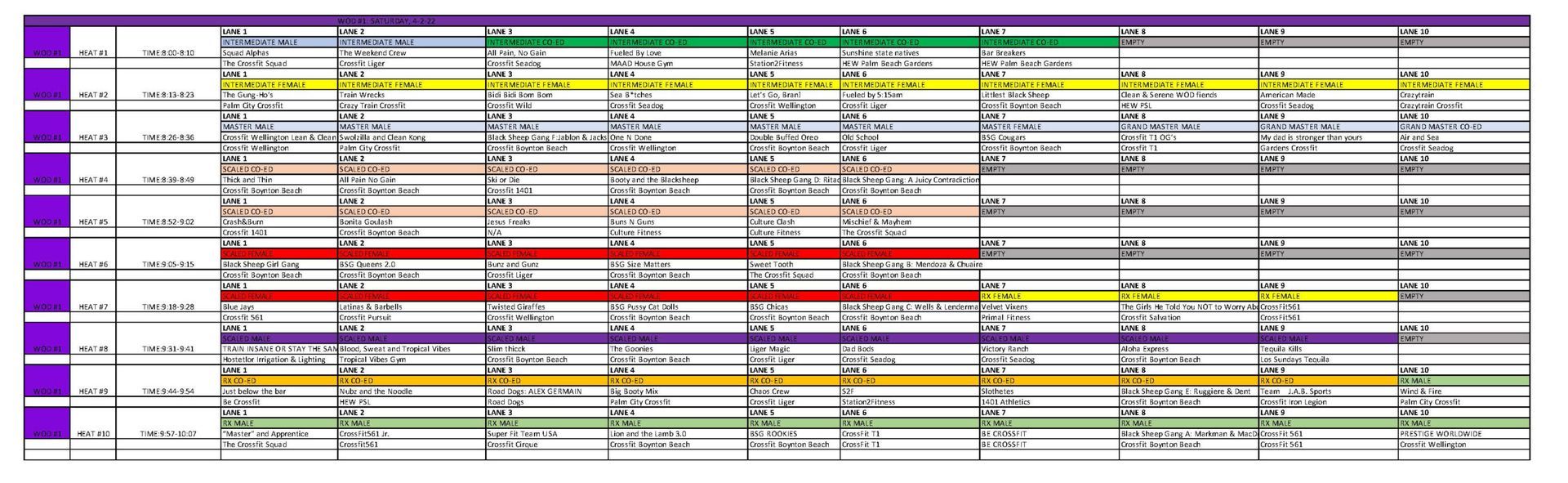
A colorful, grid-based chart, possibly a schedule or timeline, with various colored horizontal bars and text within each cell.
By Kelli March 30, 2022
SeaDog Showdown Heats – Click text to download The post SeaDog Summer Showdown 2022 Heats appeared first on CrossFit Sea Dog.
Cartoon of a man in athletic wear stretching his leg.
By Kelli October 2, 2020
Benefits of Stretching and Mobility   Stretching should be part of your daily routine, whether you exercise or not. It does not have to involve a huge amount of time, but stretching can end up having huge results. Benefits of Stretching Before and After Exercise: Reduce muscle tension and helps the body feel relaxed Avoid... View Article The post Benefits of Stretching and Mobility appeared first on CrossFit Sea Dog.
Two overlapping head silhouettes, one blue, one pink, filled with the words
By Kelli September 27, 2020
Mental Health Stress/Anxiety Relief                During these unprecedented times, the nation has seen a significant rise in mental health concerns including but not limited to, depression, stress, anxiety, etc. We have all experienced our own personal challenges related to our changes in our schedules, changes with our job status, and increased time at home with... View Article The post Mental Health appeared first on CrossFit Sea Dog.
Various fruits and vegetables pouring into a capsule, symbolizing health supplements.
By Kelli September 20, 2020
Supplements  How Can They Benefit?                Do you feel overwhelmed when walking into a supplemental store and having no idea where to begin, but know you are sore after workouts and need something to assist with your training regimen? Well, we want to help…below is beginning basic knowledge for various types of supplements.  If you... View Article The post Supplements – How Can They Benefit appeared first on CrossFit Sea Dog.
Blue thought bubble with
By Kelli September 13, 2020
Adequate Sleep How to Accomplish?                Through research it is recommended the average adult needs to get 7 to 8 hours of sleep. Due to hectic lives of modern technology, this can be difficult.  However, it is just as important to develop a schedule of adequate sleep time as it is to eat healthy and... View Article The post Are you Getting Adequate Sleep?! appeared first on CrossFit Sea Dog.
By Kelli August 31, 2020
Paleo Vs Whole30: What is the difference? While we are not here to tell you what healthy diet is the best for you, we want to provide you the information on several common ones so you can choose what the best is for you and your lifestyle.  Many CrossFitters have tried or at least heard... View Article The post Paleo Vs Whole30: What is the difference? appeared first on CrossFit Sea Dog.
Text on a blurred forest background reads:
By Kelli August 25, 2020
Where to Start, How to Start Healthy Living?! Whether you are starting from scratch or trying to get back on track, it can be overwhelming to know where to begin to set yourself up for success in becoming healthy.  First thing you need to do is to set your own personal goals of what you... View Article The post Nutrition/Wellness Challenge: Where to Start? appeared first on CrossFit Sea Dog.